 GF reinforced-General grades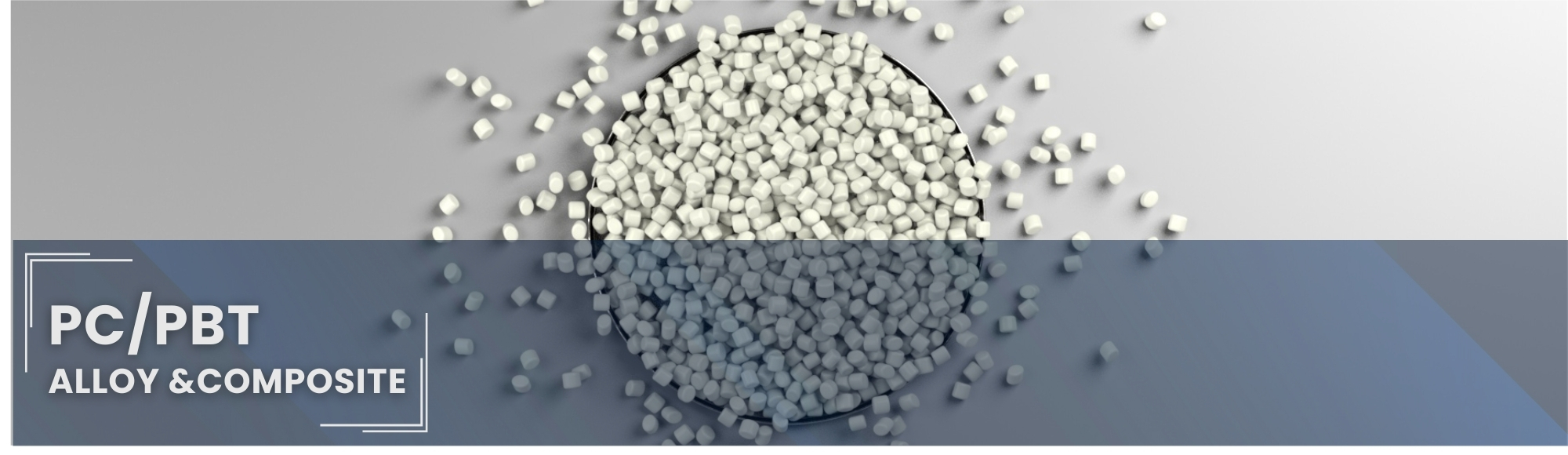
PC/PBT (Polycarbonate/Polybutylene Terephthalate Blends) is an engineering plastic composed of polycarbonate (PC) and polybutylene terephthalate (PBT), combining the advantages of both materials to provide excellent mechanical properties, heat resistance, chemical resistance, and good processability.
Mechanical and Thermal Properties
- Impact Resistance: PC/PBT has outstanding impact resistance, with an unnotched Izod impact strength typically ranging from 600 to 800 J/m, maintaining high toughness and strength even at low temperatures.
- Heat Resistance: The glass transition temperature (Tg) of PC/PBT is around 125°C, with a heat deflection temperature (HDT) ranging from 70°C to 100°C (at 1.8 MPa), making it suitable for use at elevated temperatures, while maintaining good dimensional stability even after prolonged exposure to heat.
- Low-Temperature Resistance: PC/PBT performs well at low temperatures, retaining high impact resistance and toughness in environments ranging from -30°C to -40°C without showing significant brittleness.
- Chemical Resistance: PC/PBT exhibits good resistance to most acids, alkalis, oils, and organic solvents, though it may be sensitive to strong oxidizers, strong acids (such as nitric acid and sulfuric acid), and certain ketone solvents.
Thermal Performance and Dimensional Stability
- Moisture Absorption: PC/PBT has a low moisture absorption rate, typically between 0.3% and 0.6%, with minimal dimensional changes due to moisture absorption, ensuring excellent dimensional accuracy and mechanical properties in humid environments.
- Processability: PC/PBT has good processability, with a melt flow rate (MFR) typically between 6-12 g/10 min (ISO 1133, 230°C/2.16kg), making it suitable for injection molding and extrusion processes. The processing temperature range is generally between 240°C and 270°C.
- Heat Deflection Resistance: The heat deflection temperature (HDT) of PC/PBT ranges from 85°C to 140°C (at 0.45 MPa), depending on the material formulation and whether it contains reinforcements like glass fibers. The material maintains good dimensional stability in high-temperature environments.
Material Structure and Properties
- Structural Characteristics: PC/PBT combines the high rigidity of polycarbonate with the toughness of polybutylene terephthalate, resulting in excellent impact resistance, chemical resistance, and good dimensional stability. This blended structure gives the material outstanding performance in a wide range of applications, particularly under demanding conditions.
- Modification: PC/PBT can be modified with additives such as glass fibers, mineral fillers, or flame retardants to enhance specific properties. For example, adding 15%-30% glass fibers can significantly increase the rigidity and heat deflection temperature (HDT) of the material; adding flame retardants can achieve a UL 94 V-0 rating.
Applications
- Broad Applications: PC/PBT is widely used in the automotive industry, electronics, building materials, and household appliances. Due to its excellent mechanical properties and heat resistance, PC/PBT is particularly effective in applications requiring high strength and durability.
- Automotive Components: PC/PBT is commonly used in the production of automotive bumpers, door handles, dashboards, and other interior and exterior trim parts due to its excellent chemical resistance and mechanical strength. These components require high impact strength and good surface quality, which PC/PBT materials can provide.
- Electronics: The heat resistance, flame retardancy, and good dimensional stability of PC/PBT make it an ideal material for electronic housings, connectors, and electrical components. With proper modification, the material can provide reliable performance in demanding working environments.
| Series | Description | Download |
|---|